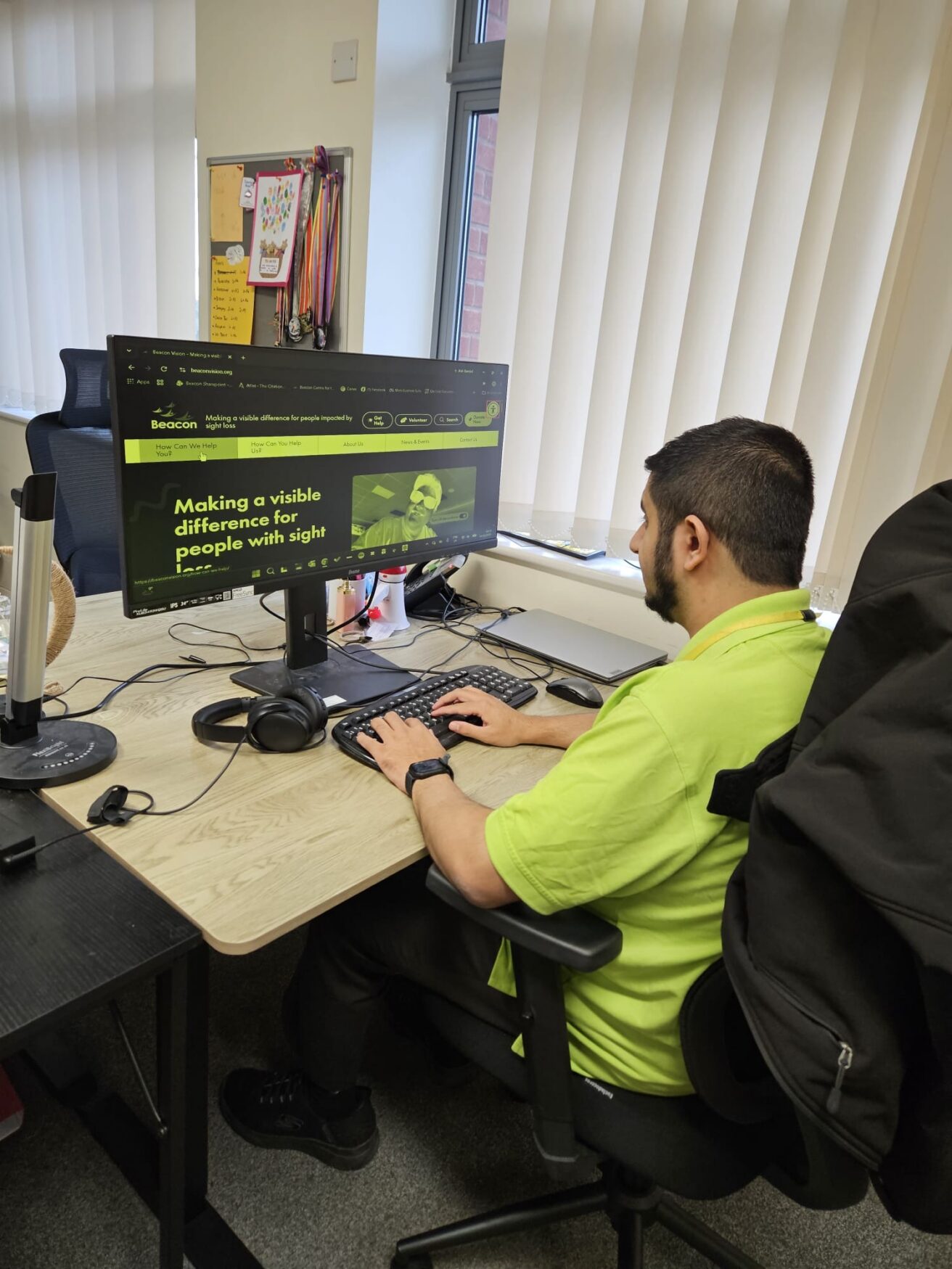
Today, Mo is building a successful career in marketing and communications working as a Communications and Engagement Officer at Beacon Centre for the Blind, alongside supporting children and young people with sight loss. He also speaks at events, contributes to accessibility initiatives, and volunteers for charities Look-UK and VICTA. Yet a decade earlier, his future looked very different.
Mo was a successful student throughout secondary school. However, during the first six months of sixth form, his sight began to deteriorate rapidly.
Subjects he had previously excelled in suddenly became overwhelming. Tasks that took classmates seconds could take him several minutes. Even logging onto a computer became a significant challenge as he struggled to see the screen and navigate using a mouse. Despite his efforts, his difficulties were often misunderstood.
‘I went from getting good grades to struggling enormously, but the assumption was that I wasn’t working hard enough.’
Although he eventually received a diagnosis, the support available in mainstream education was minimal. Adjustments were limited and specialist interventions were virtually non-existent.
As his grades fell, so did his confidence. Eventually, he was told he could not continue his A Level studies.
‘It felt like a door had been shut on me.’
After leaving school, Mo moved to a mainstream college to study graphic design. Once again, promises of support were not matched by reality. The specialist equipment he needed rarely arrived, and he continued to face barriers accessing learning.
Creativity had always been central to his identity. Graphic design was not simply a course choice; it was his intended career path. As his sight deteriorated and support remained limited, that dream began to feel increasingly unattainable.
When tutors advised that progressing further in graphic design might not be realistic, the impact was devastating.
‘It felt like everything I had planned for my future was being taken away.’
After leaving college, Mo found himself at home with no clear direction. His confidence was low and his social circle had diminished. Without specialist guidance, he was largely left to navigate sight loss alone.
‘I didn’t know what support existed. I didn’t know what technology was available. I didn’t even know things like audio description existed.’
Looking back, he describes this period as one of isolation and uncertainty.
It was during this time that he began researching specialist colleges for people with vision impairment and discovered the Royal National College for the Blind (RNC).
The journey into specialist F.E. was not straightforward.
Securing an Education, Health and Care Plan (EHCP) proved challenging, and funding was only confirmed shortly before he was due to start.
There were concerns about moving away from home for the first time, learning to live independently and adapting to an entirely new environment. For Mo’s family, who had always lived closely together, it was equally daunting.
Yet from his very first visit to RNC, it became clear that this was different. For the first time, he encountered an environment specifically designed around the needs and aspirations of blind and partially sighted students.
‘It felt like somewhere that understood what I needed before I’d even arrived.’
At RNC, Mo studied academic subjects, but it was the wider learning experience that had the greatest impact.
Alongside qualifications, he developed skills in:
- assistive technology
- touch typing
- screen reader software
- Braille
- mobility and independent travel
- independent living skills
- self-advocacy
- public speaking
- confidence and resilience
Many of the staff delivering this support had lived experience of vision impairment themselves.
‘That mattered. The advice wasn’t theoretical. It came from people who had lived it.’
For the first time, Mo learned not only how to access information but how to navigate the world as a vision impaired adult. He learned practical strategies for daily life, from cooking safely to travelling independently, from accessing technology to managing his environment.
Lessons learned at RNC influenced adaptations at home, increased his confidence using assistive technology and gave him a greater understanding of how to advocate for his own needs.
One of the most significant transformations was socially. Before joining RNC, Mo had never met other vision impaired young people his own age. At the College, he found an immediate sense of belonging.
Students openly discussed their experiences, shared practical advice and supported one another through common challenges. For someone who had spent years feeling isolated, this was transformative.
‘It felt like home surprisingly quickly.’
Conversations with peers helped him understand sight loss in new ways. Students shared technology tips, life hacks, problem-solving strategies and personal experiences.
Equally important was the realisation that sight loss did not have to define or limit ambition. Surrounded by role models, staff and fellow students who were living full, independent lives, Mo began to see possibilities instead of barriers.
Perhaps the most pivotal moment of Mo’s journey came through accessible technology.
Having believed that his future in creative work had ended, he began learning how assistive technology could work alongside design software. For the first time since losing his sight, he successfully created a promotional poster using Adobe software and screen-reader technology.
‘The moment was emotional. It sounds small, but it felt huge. I realised I could be creative again.’
That single experience reopened a door he thought had closed forever. Instead of seeing creativity as something he had lost, he began to understand it as something that could take new forms through writing, marketing, content creation, storytelling and communications.
‘It wasn’t just that I could make a poster. It was realising there were still opportunities in creative industries.’
RNC continually encourages students to move beyond their comfort zones. For Mo, this included opportunities he would never previously have considered.
He participated in the Duke of Edinburgh’s Award, travelled independently, undertook international trips, became a student ambassador and served as a student governor. Each experience building more confidence.
One of the most important achievements was learning to travel independently by train. What began as supported travel training eventually enabled him to undertake journeys alone, including travelling to London for professional opportunities.
A critical part of Mo’s story is how specialist education connected learning with real-world employment opportunities. He was encouraged to undertake work experience and through the College’s extensive employer links and transition support, he secured a work placement with CJP Broadcast Service Solutions.
The placement proved to be a significant milestone giving him different opportunities within the creative industries such as scriptwriting, blog writing, filmmaking and marketing.
Building on this foundation, RNC’s careers and transitions support helped Mo explore longer-term employment pathways. This led to a place on the Thomas Pocklington Trust’s Get Set Progress internship programme.
The internship placed him at Beacon Centre for the Blind, where he worked within communications and marketing while continuing his professional development through specialist training and mentoring.
The internship not only provided experience but opened the door to lasting employment. What began as a fixed-term opportunity developed into a paid role and ultimately a permanent position.
Today, Mo’s work spans communications, engagement and support for children and young people with sight loss.
He helps families access information and services. He acts as a role model for others beginning their sight loss journey. He speaks publicly about accessibility and inclusion and utilises every opportunity that comes his way.
Looking back, he believes specialist F.E. provided the foundation for everything that followed. RNC did more than educate him. It gave him the tools to access information independently. It gave him the confidence to travel alone. It helped him rediscover his creativity. It connected him with employers, work placements, internships and professional networks. Most importantly, it gave him a sense of belonging and possibility.
‘Specialist education helped me find a place where I belonged and discover ways of working that opened the door to opportunities and experiences I never thought possible.’
For Mo, the power of specialist F.E. cannot be measured solely by qualifications or employment outcomes.
Its real power lies in helping young people develop the confidence, independence, resilience and self-belief needed to build the lives they want.
Without specialist F.E., his journey would have looked very different. Because of it, he has built a career, a community and a future. And he is only just getting started.